For Seo Does It Hurt to Upload a Video to Multiple Sites
Call up about the last time you uploaded an image to your website. Chances are yous downloaded it from a stock photography site, uploaded it to the backend of your site, then inserted information technology to the page.
This makes a shining example of epitome optimization, correct? Not quite.
Yous've added a giant bowling ball weight to your site that'due south slowing down the page speed. And, search engines can't read your images without alt text.
Allow's change that.
Over xx% of all U.Southward. web searches happen on Google Images, according to 2018 data from Jumpshot.
SEO amateurs and pros akin know that optimizing images for your website is notoriously worth the fourth dimension spent.
Dan Morgan at WebSpection got ane of his photos to rank #i in Google Images for "best person in Cardiff" in less than four days past optimizing his image.
And, Robbie Richards generated 150,732 visits by adding image alt tags, compressing images, and a few other SEO tricks.
Without proper image optimization, you're wasting a valuable SEO asset.
It's similar the search engines are giving abroad Oreos and milk for gratuitous. But, yous only take the Oreo. When in reality, the Oreo is way better dunked in milk.
Image optimization creates many advantages such as better user experience, faster folio load times, and boosted ranking opportunities. And, it'due south becoming an increasingly more important role.
As Matt Southern pointed out, Gary Illyes' statement on image search in a recent Reddit chat:
"We but know that media search is manner as well ignored for what it'southward capable doing for publishers so we're throwing more engineers at information technology likewise as more outreach."
Simply which factors are most important to ensure your images are findable and don't deadening downwards your site?
Here are 12 important image optimization tips you demand to know.
i. Cull The Right Format
Decoding all the various image formats can feel similar your get-go fourth dimension ordering at Taco Bong. But, before y'all can start adding images to your site, you want to make sure yous've chosen the best file blazon.
While there are many image formats to choose from, the PNG and JPEG are the most common for the web.
- PNG: Produces better quality images, merely comes with a larger file size.
- JPEG: You lot may lose prototype quality, but you lot can adjust the quality level to detect a good residual.
- WebP: Choose lossless or lossy compression using this, the but prototype format supported by both Chrome and Firefox.
For me, PNG is the unsung hero of prototype formatting. But, for my daily use, PNG is the fashion to go and then convert those into WebP.
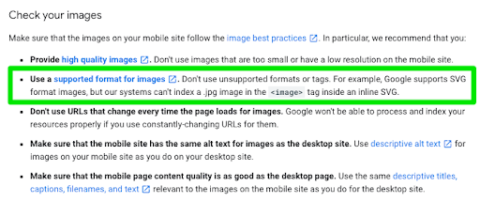
Just be careful if you're using .jpg images inside an inline SVG format as Google'southward systems can't index these.
2. Compress Your Images
Yep, hell hath no fury similar a bloated web page after uploading an image that's not compressed.
Search engines will look at your web page like y'all might look at a big vat of Crisco: You can't seriously be considering putting that on your website, correct?
Co-ordinate to HTTP Archive, images makeup on average 21% of a total webpage's weight.
That'south why I highly recommend compressing your images earlier uploading to your site. Y'all tin do this in Photoshop or you tin can use a tool like TinyPNG.
TingPNG also has a WordPress plugin you can use as well.
Even so, I prefer WP Smush as my WordPress plugin. It reduces the image file size without removing the quality.
Whatsoever plugin you use, brand sure to notice one that compresses the images externally on their servers. It reduces the load on your own site.
Or, take it a step further and employ an image CDN that detects the device and optimizes the image prior to delivery. Cloudinary and Imgix are two options to try out.
Increasingly.com improved website speed by 33%/2 seconds by compressing images.
I mean, at that place's just something sexy about faster folio speed when you shrink your images.
If yous're unsure how your images are affecting your page speed, I recommend using Google's PageSpeed Insights tool.
3. Create Unique Images
Y'all want your photos to pop on your site. If you fill your website with stock imagery, you'll await unoriginal – similar thousands of other sites that don't stand out.
Too many websites are cluttered with the same generic stock photos.
Remember about a corporate website, a consulting house, a business organization that prides itself on customer service. All these websites utilize virtually the same looking stock paradigm of a businessman smiling.
I'g sure you've seen one that looks like this:

While yous may have your stock images perfectly optimized, it won't have the same impact or potential SEO benefits every bit an original, high-quality paradigm.
The more original pictures you have, the better experience for the user and the better your odds are of ranking on relevant searches.
Keep in mind that big images are more likely to be featured in Google Detect.
Every bit Google recommends in its Advanced SEO resource,
"Big images need to exist at to the lowest degree 1200 px wide and enabled past the max-image-preview:big setting, or past using AMP."
Practice not use your logo as the epitome.
4. Beware Of Copyright
Regardless of the paradigm files you cull to use, make sure there'southward no copyright conflict.
The Postal Service is paying $3.5 million in an image copyright lawsuit. And, Skechers got sued for $2.5 million.
If Getty, Shutterstock, DepositFiles, or some other stock photograph provider owns an paradigm you lot employ, and y'all don't have a license to use it, and so you're risking an expensive lawsuit.
Under the Digital Millennium Copyright Act (DMCA), you could be issued a discover if yous have violated any copyright issues. If the owner of a piece of content sees their content on your website, they tin issue a DMCA Takedown which you must comply with.
Google Images allows you to filter results based on those available for reuse, and Mindy Weinstein shares 41 different websites to observe free images.
5. Customize Epitome File Names
When it comes to SEO, creating descriptive, keyword-rich file names is absolutely crucial.
Not customizing your prototype file name is similar getting a burrito with nothing in information technology. Information technology just plain sucks.
Image file names warning Google and other search engine crawlers as to the subject matter of the image.
Typically, file names will look like "IMG_722019" or something similar. That'south like ordering from a menu in a different language. It doesn't help Google.
Change the file proper noun from the default to aid the search engines sympathize your paradigm and improve your SEO value.
This involves a chip of piece of work, depending on how all-encompassing your media library is, merely changing the default paradigm proper name is always a good thought.
Let's pretend you have an image of chocolate for case.
I could name it simply "chocolate" merely if yous sell chocolate on your website, potentially every image can be named "chocolate-1," "chocolate-ii," then on.
I named this paradigm "dark-chocolate-coffee" to let users and search engines understand the epitome.
vi. Write SEO-Friendly Alt Text
Alt tags are a text culling to images when a browser tin can't properly render them. Like to the championship, the alt attribute is used to describe the contents of an image file.
When the prototype won't load, y'all'll get an image box with the alt tag nowadays in the top left corner. Brand sure they fit with the image and make the film relevant.
Paying attention to alt tags is also beneficial to the overall on-page SEO strategy. You want to make sure that all other optimization areas are in identify, but if the prototype fails to load for any reason, users will meet what the image is supposed to be.
Plus, adding appropriate alt tags to the images on your website can help your website achieve improve rankings in the search engines past associating keywords with images. Even Google has remarked on the value of alt text in images.
Information technology provides Google with useful information nearly the subject field matter of the image. We use this information to help make up one's mind the best image to return for a user'south query.
Alt text is required under the American Disabilities Human action for individuals who are unable to view images themselves. A descriptive alt text tin can alert users exactly what is in the photograph. For example, say you have a motion picture of chocolate on your website.
The alt text could read:
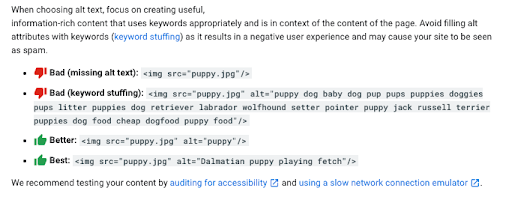
<img src="chocolate-1.jpg" alt="chocolate"/>
Notwithstanding, a better alternative text that describes the image would read:
<img src="chocolate-ane.jpg" alt="dark chocolate coffee flavored bar"/>
Alt text is viewable in the cached text version of the page, aiding in its benefit to both users and the search engines. For further SEO value, the alt text tin act as the anchor text of an internal link when the image links to a different page on the site.
seven. Think Almost The Image File Structure
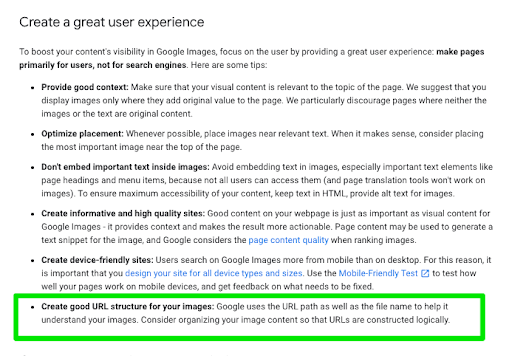
Google updated its Image Guidelines. Ane of the major updates they revealed was that they use the file path and file proper name to rank images.
Echo: The file path and file proper noun is an actual ranking cistron.
For instance, if you're an ecommerce brand with multiple products, instead of placing all your product images into a generic /media/ folder, I would recommend structuring your subfolders to more than category related topics like /shorts/ or /denim/.
viii. Optimize Your Page Title & Description
Google also revealed that it uses your page title and description as office of its epitome search algorithm.
The Google support page states:
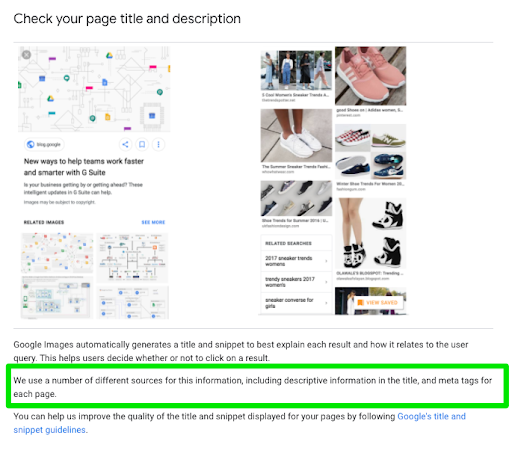
All of your basic on-page SEO factors like meta data, header tags, re-create on the page, structured data, etc. affects the way Google ranks your images.
Information technology's similar putting all your toppings on your burrito. It tastes manner better with guac. So, brand certain to add the guac for improving image rankings.
9. Define Your Dimensions
If you lot're using AMP or PWAs, you are required to define your image dimensions in the source code.
Still, if yous're not using either, it'due south even so a all-time do to define the width and height. It provides a better user experience.
Plus, it allows the browsers to size the image before the CSS is loaded. This stops the folio from jumping when information technology loads.
Image dimension attributes are also important for preventing Cumulative Layout Shift (CLS) bug that can interfere with your Cadre Web Vitals optimization.
Making certain that you include width and height attributes for every image and video element is key.
This tells the browser how much space to allocate for the resource and prevents that annoying content-shifting that lowers your CLS score. Learn more here.
10. Brand Your Images Mobile-Friendly
Oh, mobile SEO. At its worst, it can give y'all a high bounce rate and depression conversions. Just, at its all-time, it can give yous more ranking power and better user engagement.
Problem is, how do yous optimize your images for the mobile-first alphabetize?
Luckily, Google offers guidance on best practices for images.
In short, yous desire to create responsive images. This means the paradigm volition calibration with the size of the site whether the user is using desktop or mobile. It adjusts to the size of the device.
Mozilla offers a comprehensive guide on using the srcset and sizes attributes to provide the browser boosted source images, enabling the brandish of identical image content resized for the device.
Information technology is important to format this with a dissimilar part of the attribute value on each line, as demonstrated in this example from their resources:
<img srcset="elva-fairy-480w.jpg 480w,
elva-fairy-800w.jpg 800w"
sizes="(max-width: 600px) 480px,
800px"
src="elva-fairy-800w.jpg"
alt="Elva dressed as a fairy">
Learn more about using srcset for responsive images here.
eleven. Add together Images To Your Sitemap
Whether yous're calculation your images to your sitemap or creating a new sitemap for images, you desire images somewhere in your sitemaps.
Having your images in a sitemap greatly increases the chances of search engines crawling and indexing your images. Thus, results in more site traffic.
If you're using WordPress, Yoast and RankMath offering a sitemap solution in their plugin.
12. Add Structured Data
Structured information markup your content types to guide google and search engines to deliver better visual results. Essentially, Google could serve your images as a rich effect if you add structured data.
For example, if you're using schema markup on a product folio and you lot label the image as a product, Google could pair this image with a price tag. Search engines skip the algorithm and use the information provided in the structured information to provide the right image.
Image Optimization Key Takeaways
And so, before you begin uploading your image to your site, brand sure to follow the image optimization rituals from to a higher place.
The most important thing is to make sure the paradigm and alternative text are relevant to the page. Other key takeaways:
- Choose the right file format. PNGs are my favorite for screenshots.
- Reduce file size for faster page load speed.
- Make sure your on-page SEO elements (meta data, structured data, etc.) pair with your image.
- For crawlability, create an epitome sitemap or make sure your images are featured in your sitemap.
Optimizing images are no joke. With advancements in voice search engineering, media is a growing importance and your unabridged site will benefit from taking the steps to a higher place.
Happy optimizing!
Featured Prototype: Paulo Bobita/Search Engine Journal
All screenshots are taken by author
sherrillnamen1985.blogspot.com
Source: https://www.searchenginejournal.com/on-page-seo/image-optimization/

Postar um comentário for "For Seo Does It Hurt to Upload a Video to Multiple Sites"