How to Upload a File With Javascript
Note, this commodity deals with client-side JavaScript. For a client and server-side JavaScript upload example, check out this File Uploads with Node and JavaScript tutorial.
It used to be a daunting challenge for a developer to upload files through a browser. Poor client-side facilities hampered the equation, and server-side components needed to exist to handle the incoming data stream.
Fortunately, HTML5 file input form tags simplified things on the customer side. Even so, developers have added needless complication to their application when it comes to creating Ajax and JavaScript file uploads. When developers plow to popular libraries such every bit jQuery or Dojo Toolkit, they add unnecessary issues to file uploads. Thankfully, there is an easier way.
| More File Upload Options |
|---|
| I put together a bunch of file upload tutorials. Selection your technology and become uploading!
Uploading files to the server need not be a problem. |
The easiest and simplest mode for a developer to accomplish an Ajax file upload is to use pure JavaScript and get out the bulky libraries and frameworks backside.
Ajax file uploads
A developer tin perform an Ajax-based file upload to a server with JavaScript in five steps:
- An HTML5 input course element must be included in the webpage that renders in the client's browser;
- A JavaScript method must be coded to initiate the asynchronous Ajax based file upload;
- A component must exist on the server to handle the file upload and salvage the resource locally;
- The server must transport a response to the browser indicating the JavaScript file upload was successful; and
- The customer's browser must provide an Ajax-based response indicating the file uploaded successfully.
In this example, the JavaScript file upload target is an Apache Web Server. As a result, the server-side component that handles the Ajax asking will be written in PHP. If a Tomcat or Jetty server was the upload target, a developer could code a Java based uploader on the server-side.
HTML5 file tags
HTML5 introduced a new blazon of input form field named file. When a browser encounters this tag, it renders a fully functional file picker on the spider web page. When it'south combined with an HTML5 button tag that tin trigger a JavaScript method, these ii elements represent the required markup elements to begin the JavaScript and Ajax file upload process.
The following HTML5 tags provide the required components to add a file selector and an upload push to any web folio:
<input id="fileupload" type="file" proper noun="fileupload" /> <button id="upload-button" onclick="uploadFile()"> Upload </push button>
The button kicks off a method named uploadFile(), which contains the JavaScript file upload logic.
<script> async function uploadFile() { let formData = new FormData(); formData.append("file", fileupload.files[0]); await fetch('/upload.php', { method: "Mail", trunk: formData }); alert('The file has been uploaded successfully.'); } </script>
JavaScript file upload logic
The above script tag contains zero but pure JavaScript. There'southward no jQuery or Dojo thrown into the mix and the logic is straightforward:
- Create a FormData object to contain the information to be sent to the server;
- Add together the chosen file to be uploaded to the FormData object;
- Asynchronously telephone call server-side resource to handle the upload; and
- The server-side resources is invoked through the Mail service method
- The server-side resource is passed the FormData which contains the file
- In this case that server-side resource is named upload.php
- When notified that the JavaScript file upload was successful, send an Ajax based warning to the client.
All the HTML and JavaScript logic will be contained in a unmarried file named uploader.html. The consummate HTML looks every bit follows:
<!DOCTYPE html> <html> <head> <title> Ajax JavaScript File Upload Example </title> </head> <body> <!-- HTML5 Input Class Elements --> <input id="fileupload" type="file" name="fileupload" /> <button id="upload-push button" onclick="uploadFile()"> Upload </button> <!-- Ajax JavaScript File Upload Logic --> <script> async function uploadFile() { let formData = new FormData(); formData.append("file", fileupload.files[0]); await fetch('/upload.php', { method: "POST", body: formData }); alert('The file has been uploaded successfully.'); } </script> </body> </html>
Apache file upload processing
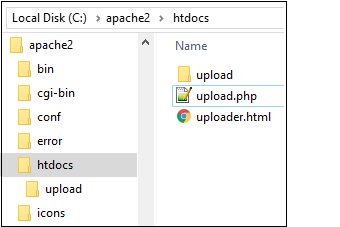
Required JavaScript file upload components.
When an asynchronous JavaScript file upload happens, a server-side component must be to handle the incoming file and store it. Since this example uses an Apache HTTP Server (AHS), and since PHP is the language of AHS, information technology requires a file named upload.php that contains a small-scale PHP script to save the incoming file to a folder named uploads:
<?php /* Get the name of the uploaded file */ $filename = $_FILES['file']['name']; /* Choose where to save the uploaded file */ $location = "upload/".$filename; /* Salvage the uploaded file to the local filesystem */ if ( move_uploaded_file($_FILES['file']['tmp_name'], $location) ) { echo 'Success'; } else { echo 'Failure'; } ?>
The PHP script is likewise straightforward. It obtains the name of the file beingness uploaded, so creates a spot in a folder named upload to save the file. PHP'southward move_uploaded_file method is then used to salvage the uploaded file to this new location.
Run the JavaScript file upload example
The files used in this example, along with a folder named upload, must exist added to the htdocs folder of AHS. When a client accesses the uploader.html file through a browser, the client will be able to upload a file to the server using Ajax and pure JavaScript.
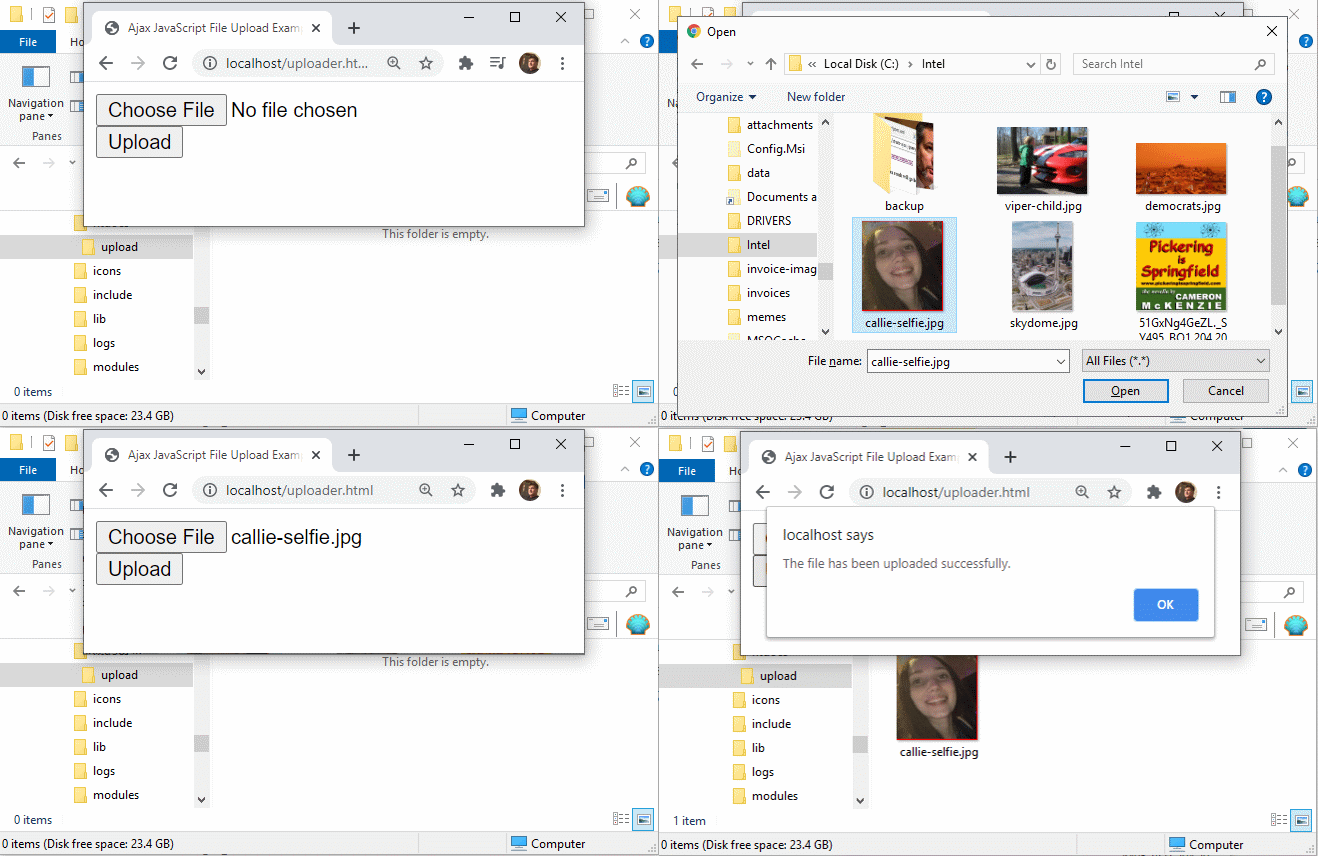
A pure JavaScript file uploader simplifies Ajax based interactions with the server.
sherrillnamen1985.blogspot.com
Source: https://www.theserverside.com/blog/Coffee-Talk-Java-News-Stories-and-Opinions/Ajax-JavaScript-file-upload-example

Postar um comentário for "How to Upload a File With Javascript"