how to tell what geberation of google nest you have
How to tell which Nest thermostat you lot have
Nest thermostats look similar, and share similar software, but there are some important differences that you'll need to know for troubleshooting, installation and more. You lot can look at the display, the base, the Heat Link, or in the Nest app to find out which Nest thermostat you have.
Here are a few ways of telling the departure between each Nest Thermostat. The easiest matter to do is look at the brandish.
Differences in the ring and brandish
The table below shows key differences betwixt Nest thermostats.
| Nest Thermostat E | tertiary gen | 2d gen |
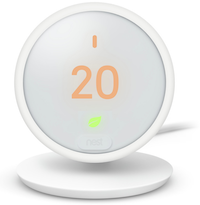 | 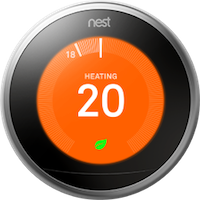 |  |
| iv.6 cm illuminated screen diameter | 8.25 cm illuminated screen bore | 7 cm screen illuminated screen bore |
| Sensor behind Nest logo | Sensors hidden behind smaller opaque window | Sensors hidden behind smaller opaque window |
| White plastic ring | Stainless steel ring: can also be colored copper, white or blackness. | Stainless steel band |
| Integrated stand (included) | Stand sold separately | Stand sold separately |
The3rd generation Nest Learning Thermostat's stainless steel ring can be different colors such as copper, white, or black. If you have a thermostat ring that looks like one of these, you lot accept a 3rd generation thermostat.
Nearly the 2nd gen Nest Learning Thermostat in Europe
The first Nest thermostat bachelor in European countries was the 2nd gen Nest Learning Thermostat. Heating systems in Europe are very dissimilar from those in the US and Canada, and we wanted to deliver the best possible experience and energy savings from the starting time. So, we took the time to blueprint and engineer an entirely new version of the Nest thermostat.
Differences in the thermostat base
If looking at the display isn't enough to tell you which thermostat you take, you can also pull off the display and look at the base. You should be able to tell right away. See the tabular array below for key differences between the different Nest thermostat bases.
| Nest Thermostat Eastward | 3rd gen | 2nd gen |
| | | |
| Integrated stand up | Blue spirit level Oval brandish connector Smaller Nest logo | Yellow spirit level Rectangular brandish connector Large Nest logo |


Differences between Oestrus Links
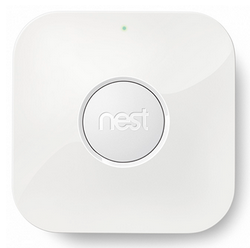
You lot can also see the divergence between each thermostat'southward Heat Link.
| Nest Thermostat Eastward | 3rd gen | second gen |
| | | |
| Gray fabric embrace Ii status lights | White plastic body Iii condition lights | White plastic trunk One condition calorie-free |
| Width 11.7 cm ten Depth 2.two cm | Superlative 11 cm x width 11 cm x depth 2.eight cm | Height 10 cm x width 10 cm x depth ii.9 cm |


Differences in the Nest app
The app colors and design volition reflect which thermostat you take.
| Nest Thermostat E | 3rd gen | 2rd gen |
| The app background will exist mostly white and shades of gray. | The app background volition be black or orangish when heating to | |
| |
| |


| You tin too observe out which type and generation of
For example, the display model in the case pictured is |  |
Check the box for a series number
Look on the bottom of your Nest Thermostat's box. You should find a serial number and you may besides see an particular number. You can use these numbers to determine which thermostat you lot have.
Use the starting time ii digits of your series number to place your thermostat
- S/N: 15 – Nest Thermostat Eastward
- S/N: 09 – 3rd gen Nest Learning Thermostat
- S/N: 02 – 2nd gen Nest Learning Thermostat
Example: serial number 09######## is for a third gen Nest Learning Thermostat
Use the first two characters of your item number to place your thermostat
- Item: HF - Nest Thermostat E
- Item: T3 – tertiary-generation Nest Learning Thermostat
- Item: T2 – 2d-generation Nest Learning Thermostat
Example: Item number T3####### is a 3rd gen Nest Learning Thermostat.
Displays and bases of unlike thermostat models aren't interchangeable
-
As long equally the thermostat base is from the same model, generation, and country/region as the thermostat display, you tin can swap bases and displays.
-
Because of unlike hardware designs, the displays and bases of various Nest Thermostat models are not interchangeable fifty-fifty though they may look like. The display connector and system wire connectors vary from model to model. Please run across the first two sections in this article for more details.
Alarm: Attempting to connect parts from dissimilar Nest Thermostat models may damage your thermostat also as your system.
-
The brandish connector on the thermostat base is different for all 3 generations of the Nest Learning Thermostat. In addition, the connectors for the system wires are different between thermostat models.
-
Annotation: 3rd gen Nest Learning Thermostats come in several colors. All 3rd gen display colors will all work with whatever tertiary gen base.
High voltage and low voltage parts aren't interchangeable
Some countries (such as the UK, French republic, and Kingdom of the netherlands) employ loftier voltage wiring for thermostats while others (such as the US and Canada) use depression voltage wiring. Nest designed unlike thermostats for high and low voltage organisation wiring. High voltage and low voltage Nest Thermostat parts are not compatible.
WARNING: Whatsoever attempt to connect low and high voltage Nest parts may damage them likewise as your system. Practice not mix and lucifer these bases and displays, even if the thermostats are the same model and generation.
You can tell which blazon of base you have by looking at the wire connectors:
- Low voltage wiring: 6 or viii connectors, labeled with messages similar Y1, W1 and C.
- High voltage wiring: 2 connectors, labeled with T1 and T2, or not labeled at all.
| Depression voltage wiring | Loftier voltage wiring |
| 6 or 8 connectors, labeled with letters like Y1, W1 and C. | 2 connectors, labeled with T1 and T2, or not labeled at all. |
| Example: | Instance: |


Was this helpful?
How can we ameliorate it?
sherrillnamen1985.blogspot.com
Source: https://support.google.com/googlenest/answer/9246551?hl=en-GB
Postar um comentário for "how to tell what geberation of google nest you have"